Editor’s note: This is a reader’s story, shared with us in her own words. Names and a few identifying details have been changed. We’re publishing it because so many of you have told us it sounds familiar.
It happened at a dinner party, which is the worst possible place for it to happen.
An old friend — someone I hadn’t seen in two years — turned to me across the table and asked, in the easy way people do, “So what do you do for fun these days?”
And I opened my mouth, and nothing came out.
Not a hesitation. Not a polite “oh, you know, this and that.” A genuine blank. Like she’d asked me to name a color that doesn’t exist.
I said “reading.” It’s what I’ve always said. But I hadn’t finished a book in three years. I’d started eleven.
I wasn’t drowning
Before I tell you the rest, I want to be clear about something. I’m not going to pretend I had it harder than anyone else.
I’m a 36-year-old project manager. I have two kids — seven and four. A husband I love, who is a good man but not the kind who notices the dishes are piling up. A mother in another city, 72, who calls every Sunday and is lonely in a way I don’t have a fix for. A junior colleague at work who asks me everything, because I’ve made it my job to be the person who has answers.
I wasn’t drowning. That was the problem. I was treading water so competently that everyone — my mother, my husband, my colleague, the people at the dinner party — assumed I was fine.
Including me.
A thinning, not a collapse
There’s a kind of tiredness that doesn’t look like anything. It doesn’t put you in bed. It doesn’t make you cry. It just slowly removes things.
I stopped finishing books. I stopped having an opinion about restaurants — I always said “whatever you want.” I stopped noticing the season. When my daughter showed me a drawing she’d done at school, I heard myself say “that’s lovely, sweetheart” in a voice that sounded exactly like I meant it, but didn’t.
The worst part: I started crying at small things. I lost my son’s soccer cleats for the third time and sobbed in the hallway for what felt like ten minutes. A package arrived dented and I had to sit down.
None of it was dramatic enough to mention. None of it was enough to ask for help with.
The mug I couldn’t place
One Tuesday — I remember it was Tuesday because the recycling goes out on Wednesdays — I was in the kitchen at 10:40 p.m., holding a clean ceramic mug.
And I stood there. Because I could not remember whether I had already put it away or was about to.
It was a mug I had used every morning for six years. It was in my hand. And for maybe thirty seconds, I did not know what it was doing in my hand, or what I was supposed to do next with it.
That’s when it got through to me. Not dramatically. Just — oh. I’m not okay. I’ve not been okay for a while. And I’ve been so good at being useful that nobody has thought to ask.
Things I tried (and why they didn’t work)
I did the obvious things. I booked a weekend at a spa. I came back more tired, because I’d spent the whole time thinking about everything I was supposed to be catching up on when I got home.
I downloaded a meditation app. Four days in, I noticed I was meditating productively — planning my week in my head during the body-scan. The app said I was “consistent.” I was a disaster.
I tried “going to bed earlier.” I lay in the dark from 9:30 to 11:00, brain louder than it had been all day, and got up more tired than when I’d gone down.
The pattern, looking back, is embarrassing in its obviousness: I was trying to rest in the gaps. I was trying to fit recovery into a schedule that had no space for it, in the leftover minutes between one person who needed me and the next. There were no leftover minutes. There never are.
The sentence my sister said
I told my sister about the mug. On the phone, between her children’s homework arguments, she went quiet for a second. Then she said, very simply:
“You keep waiting to earn it.”
And I just sat with that for a while. Because she was right.
I had quietly decided, somewhere along the way, that rest was something you received after — after the kids were in bed, after the laundry was done, after the project shipped, after my mother had called and I’d cheered her up, after everyone in my life was okay. A reward at the end of a list that never actually ended.
So I never rested. Not because I didn’t have time. Because I hadn’t yet earned it.
Fifteen minutes
Here’s the part where, in the wellness articles, the writer would tell you I bought some beautiful thing and everything changed. I want to be honest: that isn’t what happened.
What happened is I decided to take fifteen minutes a day. That’s it. No conditions. No “after the kids are asleep and I’ve cleaned the kitchen.” Just — fifteen minutes, every evening, that I was not allowed to spend on anyone, including the version of me that had a to-do list.
I put it in my calendar. I told my husband. I told myself.
The first night, I sat on the sofa and didn’t do anything, and it was the hardest fifteen minutes of my week. I felt guilty, bored, restless. I picked up my phone three times and put it down.
What I did in those fifteen minutes
After a few days, the restlessness settled, and I started to figure out what I actually wanted to do with the time. I want to be specific, because the wellness world will tell you it has to be something transformative. It doesn’t.
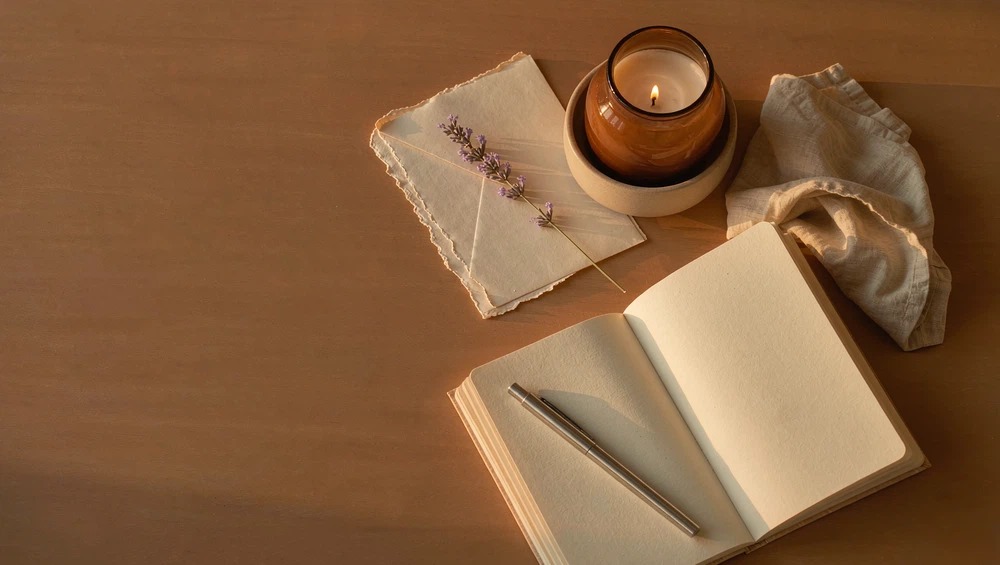
I lit a candle. Not for any reason. Just because the kitchen smelled like dish soap and I wanted it to smell like something else.
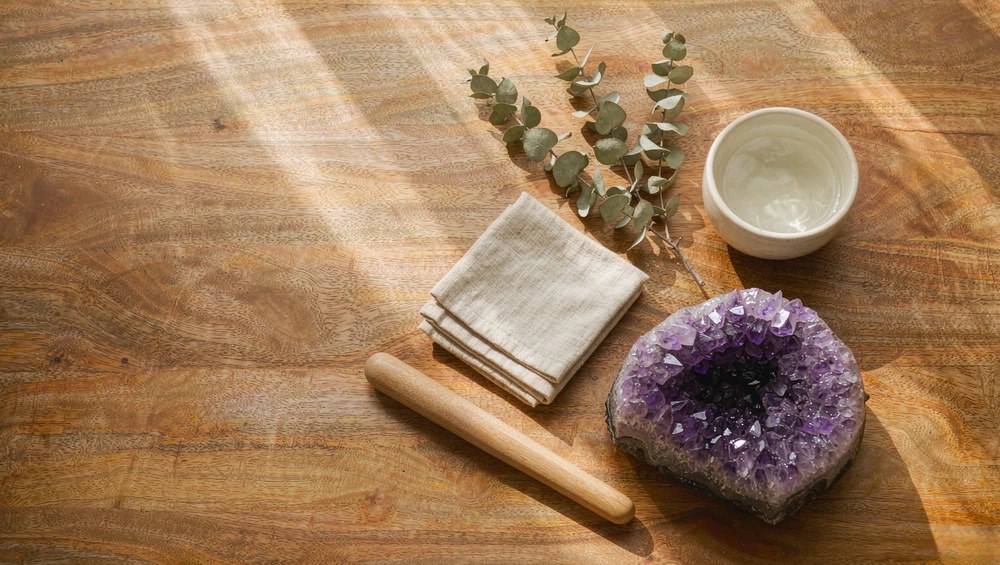
I let my hands hold something with weight to it. A smooth stone from a trip I’d taken years ago. A heavy book. It didn’t matter what it was. What mattered was that my hands had something to be with that wasn’t a phone.
Sometimes I read. A page. Two pages. I didn’t finish anything. I just let my eyes rest on sentences that had nothing to do with my life.
And then I went to bed. Usually a little before midnight, instead of a little after.
I want to be precise about this, because I’ve read enough of these stories to know how they usually go. The candle did not fix me. The stone did not heal anything. What they did was smaller and more useful than that. They marked a boundary. They told my body: the day is over. You are allowed to be finished.
The day I noticed I had a preference
About three weeks in, something happened I didn’t expect.
My husband asked what I wanted for dinner. The old answer — “whatever you want” — came up automatically, and I stopped it. I thought for a second. I said I’d prefer the Thai place, because I liked the way they did the basil, and I hadn’t said that out loud in I don’t know how long.
I had a preference. Not because it was useful. Not because anyone needed me to have one. I just liked it.
It sounds small. It’s not. If you’ve ever gone long enough without one, you know.
Where I am now (honest)
I’m not going to tell you I’m fixed. I’m not.
Last week I forgot to pick up my son from soccer practice. He waited fifteen minutes. He was fine. I was not.
Some weeks I do my fifteen minutes every night. Some weeks I don’t do it for three or four days, and I feel myself starting to thin out again — the way you might feel yourself catching a cold, but for your mood.
What I have now, that I didn’t have before, is that I notice. I notice earlier. I don’t stand in the kitchen holding a mug I can’t place. I just feel the edge of it, and I do the smallest possible thing — sit down for five minutes, light a candle, hold something heavy — and usually that’s enough to keep me on my own side.
If you’re reading this at 11 p.m.
If you’re reading this on your phone in bed, exhausted, and you don’t know when you last did something just because you liked it — I want to say a few things.
You are not lazy. You are not weak. You are not “too sensitive.”
You may simply be a person who has been useful to everyone around you for a long time, and nobody has asked whether you were okay. That’s not your fault. And the fix is not to be more useful. The fix is to spend fifteen minutes being completely, unapologetically useless — every day, whether you’ve earned it or not.
You don’t need a weekend away. You don’t need a retreat. You don’t need to “figure out what’s wrong.” You just need fifteen minutes. Take them tonight. Not because everything is done. Everything will never be done. Take them because you are a person, and people are allowed to stop.
And if you find, like I did, that the hardest part isn’t the time — it’s not knowing what to do with it once you have it — then let me tell you what I wish someone had told me:
You don’t have to do anything with it. The first few nights, you don’t even have to enjoy it. You just have to not spend it on someone else. That is the entire job. The rest follows.
I’m still tired, sometimes. But I’m no longer forgetting what I like. And that, more than anything, has been the difference.