We see you.
You got through the day. You answered the messages. You did what needed doing. And then the sun went down, the house went quiet, and suddenly everything you’d been holding at arm’s length came rushing in.
The same worry that felt manageable at 2 p.m. now feels enormous. The thing you’d rationalized now feels like proof. You’re not imagining it — and you’re not weak.
Something real is happening in your body after dark. Here’s what it is.
1. Your daytime buffer clocks out
Throughout the day, your body maintains higher levels of cortisol — the hormone that helps you respond to stress, stay alert, and keep moving. It’s not the villain it’s made out to be. In reasonable amounts, it’s part of what lets you function.
But cortisol follows a daily rhythm. It peaks in the morning and declines toward evening. As it drops, so does some of the chemical scaffolding that was helping you stay upright.
Nothing went wrong. The support simply went home for the night.
2. The rational part of your brain is tired
Your prefrontal cortex — the region responsible for perspective, planning, and putting things in proportion — is metabolically expensive to run. After a full day of decisions, it’s depleted.
Meanwhile, your amygdala, the brain’s alarm system, doesn’t get tired in the same way. So at night, the balance quietly shifts: less regulation, more alarm. A worry that would have been filed away at noon now loops without a brake.
3. Your body still remembers that night was dangerous
For most of human history, darkness meant vulnerability. Fewer eyes, fewer hands, less warning. Vigilance after dark wasn’t anxiety — it was survival.
That wiring didn’t disappear just because we now have locks and streetlights. Part of your nervous system still treats nightfall as a reason to stay alert.
4. Modern life removed the off-ramp
Our ancestors had a clear signal that the day was ending: the light changed, the temperature dropped, the noises stopped. Their bodies received an unambiguous message.
Today, screens keep our eyes in daylight-spectrum light until midnight. Messages arrive at 11 p.m. The workday bleeds into the evening with no ceremony. We removed the signal that used to tell our bodies the day was over — and then wondered why we can’t power down.
So here’s the truth worth holding onto: you haven’t become more fragile at night. The things that were protecting you during the day have simply stood down. That’s not a personal failing. That’s a body following instructions written long before you were born.
Give your evening a landing strip
You can’t override biology with willpower. But you can send the signal your body used to get for free — that the day is ending and it’s safe to stand down.
This isn’t a 60-second rescue technique. It’s a transition — a repeated message, sent at roughly the same time each evening, that eventually your body learns to recognize. Think of it as a landing strip for the day:
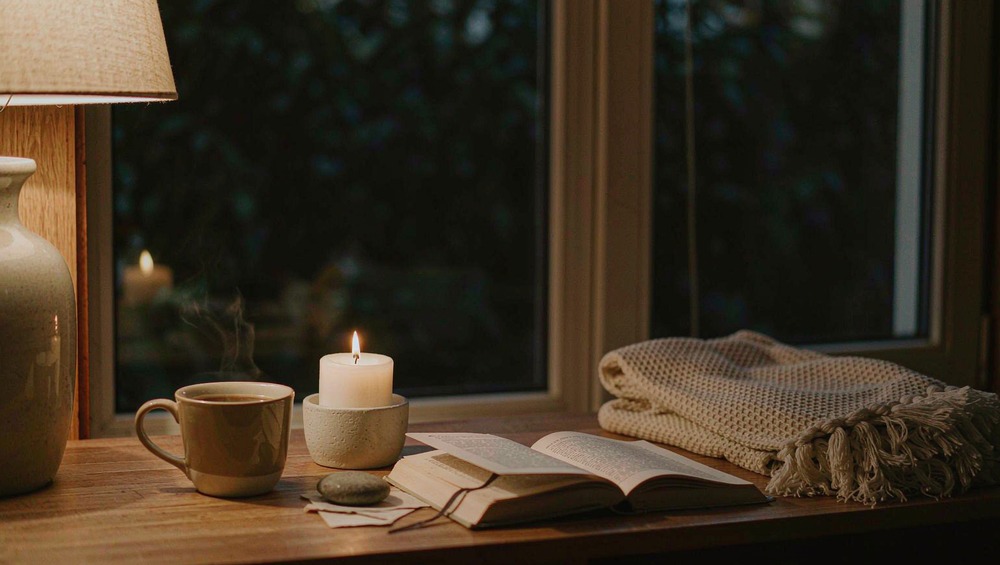
- Light: an hour before bed, lower the lights. Lamps instead of overheads. Warm instead of white. Your eyes are the primary channel through which your body reads the time of day.
- Scent: choose one scent you use only in the evening — lavender and bay laurel, perhaps. Scent reaches the emotional centers of the brain faster than almost any other sense, and repetition turns it into a cue.
- Sound: swap stimulating audio for something wordless and slow. Lyrics and conversation keep the verbal centers of your brain working; a singing bowl or a bamboo wind chime lets them rest.
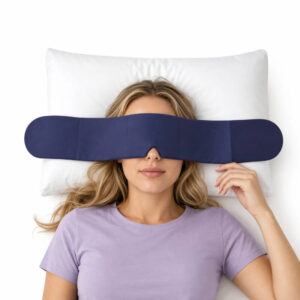
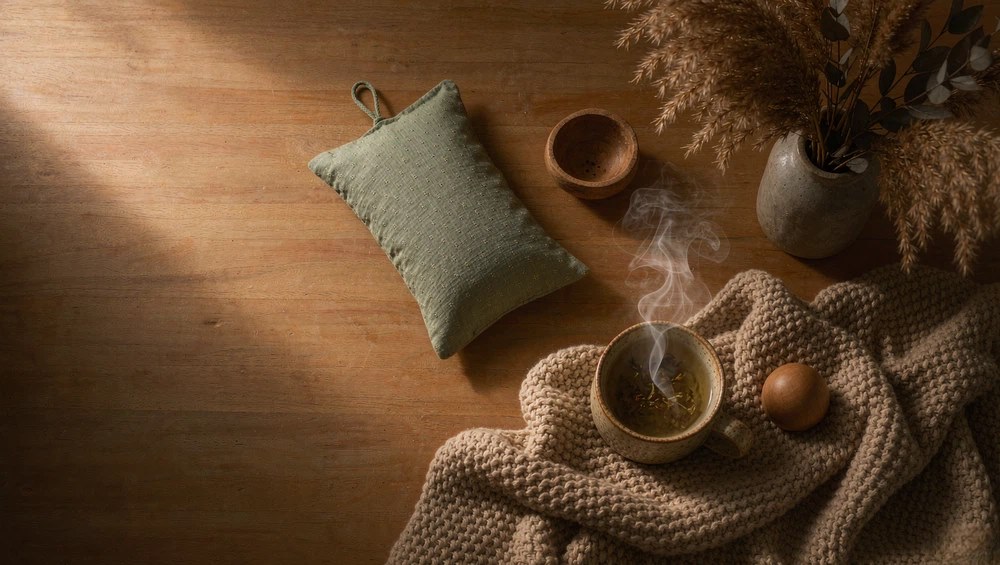
- Touch: something warm and weighty — a weighted eye mask, a mug held in both hands, a blanket. Physical weight and warmth communicate safety in a language older than words.
You don’t need all four. Start with one. Do it at roughly the same time for two weeks, and notice whether the evenings begin to feel less like a cliff and more like a slope.
And if you need help right now
This article is about understanding — not emergency relief. If you’re reading this at 2 a.m. and you need something now, our emotion check-in on the homepage will meet you where you are in this moment, with something you can do in the next sixty seconds.
Either way: the night will pass. It always has.